

Search
87 results found for "Maryellen Rooney Moreau"


Maryellen Rooney Moreau Honored by Boise Peace Quilt Project
Making the world a better place for children. That’s what an Easthampton woman has done through her work in helping children solve problems. Maryellen Rooney Moreau is a speech and language pathologist. She was a professor at American International College and twenty years ago founded MindWing Concepts, a business that creates tools to help children communicate better to solve problems and resolve conflict. Maryellen says, “The tools that I’ve created over the past many years, 20 years, that I’ve been a speech and language pathologist for over 35 years, and the focus has always been to help children who maybe have ideas in their head, but can’t get the ideas out. So to foster that in areas of reading and writing, but especially in the area of social communication.”...
UMASS Amherst Alumna Maryellen Rooney Moreau Turns Honors Thesis Into Lifelong Pursuit
Maryellen Rooney Moreau '68 is one alumna who has turned her undergraduate thesis into a lifelong career. Over 40 years ago, Moreau completed an honors thesis on language development in the department of communication arts and sciences, which is now known as communication disorders. Her thesis prompted a continued interest in researching the link between oral language development and literacy, turning Moreau into an entrepreneur whose business has changed the way educators teach...


Is Maryellen Actually “Maryellen Who?”
 Theodor Seuss Geisel, better known to the world as Dr. Seuss, was born in 1904 on Howard Street in Springfield, Massachusetts – which is right around the corner from MindWing’s office. The Dr. Seuss National Memorial Sculpture Garden is located at the Springfield Museums near our office as well. The influence of Ted’s (Dr. Seuss’) memories of Springfield can be seen throughout his work.
In keeping with the spirit of the holiday season, we wanted to share a lesson idea from MindWing’s book: East Meets West for the Holidays by Maryellen Rooney Moreau and Judy K. Montgomery. This lesson is based on one of Dr. Seuss’ most beloved holiday stories: How the Grinch Stole Christmas.


Maryellen Moreau Recipient of the 2014 Alice H. Garside Award by the International Dyslexia Association, Massachusetts Branch
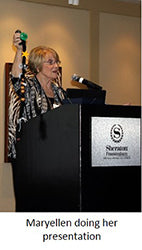 Maryellen Rooney Moreau, MEd, CCC-SLP, founder and President of MindWing Concepts, Inc. received the 2014 Alice H. Garside Lifetime Achievement Award from the International Dyslexia Association, Massachusetts Branch (MABIDA) for “exemplary leadership, service or achievement in a field that directly or indirectly furthers the mission of MABIDA.” MABIDA’s mission, in part, ´promotes, encourages and supports the preparation and continued education of professionals and other personnel to ameliorate the impact of dyslexia and related disorders and to promote optimal methods of reading instruction for all children.” Maryellen’s work certainly fits this criteria.


Mondays with Maryellen
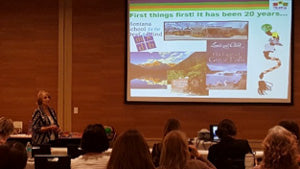 Hi Everyone! I’m sorry this post is a couple of days late – “Mondays with Maryellen” is on Wednesday this week ☺. We just returned from a whirlwind series of workshops in both San Antonio, Texas and Billings, Montana. We had great audiences, fabulous times with colleagues, and of course the San Antonio RiverWalk, the Alamo and the Big Sky Sunsets were marvelous to visit. Sheila’s 20-month-old daughter Casey and our friend Mary accompanied us on this trip — we’ve included some photos!
San Antonio was 95 degrees – wow! Billings was comfortable in the 70s. However, when we returned to Massachusetts, it was to a 19-degree morning! Alas, Fall, the prelude to snow in New England!
The trip to Billings and the return to the 19-degree morning prompt me to relate a new invitation we’ve received: A visit to Alaska upon the invitation of AKSHA—Alaska Speech Language and Hearing Association 2016 Convention next October...


FB Live with Maryellen, “Talk and Work It Out“
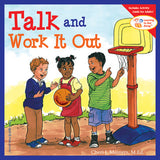 Maryellen Rooney Moreau of MindWing Concepts reads Talk and Work It Out for purpose of Problem-Solution analysis and discussion with students.


FB Live with Maryellen, “What If Everybody Did That?”
 For the past three weeks especially, our lives have been changed because of the Covid19 virus. Since school is closed and children are “schooling at home”, there is an increasing need to be able to talk to and listen to each other with compassion and also to be able to tell each other what is happening within our own lives. These mini-lessons are designed as a support for you as parents, grandparents, teachers, therapists, speech/language pathologists and of course the CHILDREN in your care. All lessons presented over the past three weeks are related to each other and were designed to build upon the concept of “telling and understanding” stories for academics and very importantly, for life during these uncertain times!...


FB Live with Maryellen, “My Day Is Ruined” Kick-Offs, Feelings, Thoughts & Plans
 Facebook Live with Maryellen
In our daily mini-lessons during these uncertain times, we, at MindWing Concepts, Inc., are providing book titles, many available online, to read to children about the not-so-huge situations that make us feel “not so great,” as well as those that contribute to feelings of well-being. We have provided “feeling bookmarks” for talking about the names of feelings to help us talk about some of these big and smaller situations that we call “kick-offs.” There are many ideas in the handouts provided during these mini-lessons that will help to show relationships of characters’ feelings to kick-offs and the thinking and planning necessary to deal with them. Using the icons to bolster listening comprehension will spur and organize our discussions. Everyone needs to talk! We just have to think about how to do it during these times!...
Maryellen Presenting at 7th Annual Social Thinking Providers’ Conference / FREE “The Worrywarts” lesson!
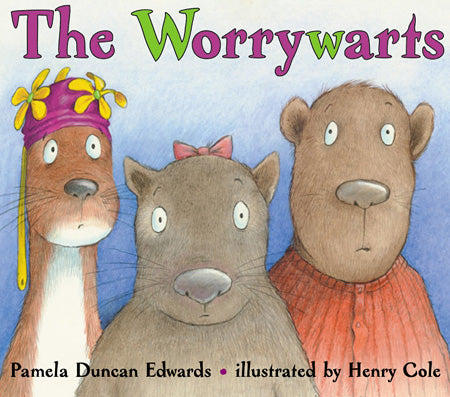 Maryellen Rooney Moreau is presenting again at the Social Thinking Providers’ Conference in South San Francisco on June 20! Having presented with Michelle Garcia Winner in her four initial Traveling Providers Conferences (Boston, Dallas, Chicago, Minneapolis, 2013), we have been receiving much interest in our professional development opportunities and our many tools for narrative development and social communication. Narratives can be used to facilitate the building the gestalt or the “big picture.” Narrative ability is much more than a simple story retell. In fact, it is a window into oral language development, listening and reading comprehension, written expression and social communication through the communication of feelings and thoughts. Narrative development and its stages are present in language and cognitive research dating back to the late 1970s. Using our tools assists in informing instruction and designing intervention for students in general education, special education and students who are learning English as a second language...


Maryellen’s Analysis of Emma’s Sample
 The following is an analysis of Emma’s written expression of Too Many Tamales. (See previous blog, Analyze A Narrative Written Sample.) Emma’s third grade teacher considered her to be among the top writers in the class and we agree! We’ve included a typed version of her writing, an analysis and a conference suggestion for use during the Writing Process. In our conferencing points, we included mapping using samples of the Story Grammar Marker® iconic maps. If you are not familiar with our Data Collection tools, we have a wide variety to accommodate student needs and your intervention goals. There are also student tools that will assist students in assessing their own work. Below is a sampling of how I would approach conferencing with Emma...


Maryellen’s Analysis of 5th-Grade Writing Sample
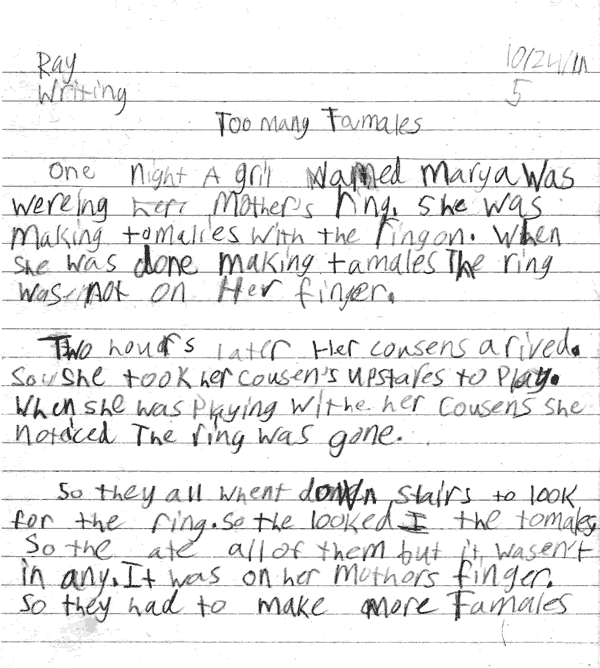 This next written retell of Too Many Tamales is by Ray, a student in Grade 5. We’ve included a typed version of his writing, an analysis and a conference suggestion for use during the Writing Process. The descriptive details in Emma’s writing (see May 13 blog) and the use of story grammar components indicating advancing structure and content are evident—but to a lesser degree—in Ray’s sample.
Perspective Taking in Literature
Maryellen Rooney Moreau presented last weekend at Michelle Garcia Winner’s Social Thinking Providers’ Conference in San Francisco. In 2003, Winner stated: “Perspective taking is needed for social interaction, academic success and personal problem-solving as an adult.” Social Thinking, the work of Winner, heavily focuses on perspective-taking. Maryellen’s presentation, meant to exemplify this statement, was called Let’s Think About It! Perspective-taking And The Thought Process Of Opinion/Argument Using The Story Grammar Marker®. In her presentation she covered the following topics:
- Narrative development in relation to perspective taking
- Speaking and listening Common Core State Standards and narrative development
- The role of mental models and social emotions in perspective taking
- The Situation Model and the Story Grammar Marker®
- Critical thinking and its relation to perspective-taking and argument
- The shift to Expository text structures in ELA due to the Common Core State Standards
- Thinking about, planning and writing opinion & argument


There is a new “character” at MindWing Concepts!
 We are thrilled to share that on February 17th, Maryellen Rooney Moreau welcomed her 4th grandchild into the world! Casey is Sheila Moreau's first child and Maryellen's 3rd granddaughter. This is the first picture of Casey that was taken.
She continues to be very alert and Maryellen is already studying her language development, noticing that Casey focuses her eyes on the “characters and settings” around her. Casey loves the sound of Nana’s voice (as do so many of Maryellen’s workshop participants)! Today, on March 17th, St. Patrick's Day, one of our favorite holidays, Casey is one month old!..
Adult/Child Interaction
Maryellen is having a conversation with her granddaughter Lauren at the age of two. Notice how Maryellen used a cuddly toy cow to encourage Lauren to remember a visit to a farm. The two had experienced the event is real time. This interaction centers on the memory of the visit and is expressed as a personal narrative...


Coming Late Spring: the Story Grammar Marker® App: You are A Star Reporter!
It has been a long time coming, but MindWing Concepts has partnered with three talented Speech Language Pathologists: Meghan Graham, Karen Head and Jill Perry of All4MyChild www.all4mychild.com) to create the Story Grammar Marker® App! All4MyChild is the creator of The Bag Game©, the Social Adventures© App, Talking Train© and Fun Timer©. They have used Story Grammar Marker® extensively for years. As regular readers of our Blog know, Sean Sweeney (www.speechtechie.com) has written many, many Blog entries where he teaches how to incorporate Story Grammar Marker®, ThemeMaker® and our other products with various Apps and web-based technologies. His expertise, enthusiasm and ingenuity has always been an inspiration to MindWing, helping us to see how this platform is a "must" for SGM®. It will be exciting to now see the use of Story Grammar Marker® in its own App format. Thanks to the creativity and technical knowledge of all4mychild.com, the SGM® App has become a reality.


NEW! COMMON CORE BOOK and FREE LESSON

The aligning of the Common Core State Standards with MindWing’s methodology can provide effective, evidence-based interventions to help students who are “at-risk” and those with identified disabilities to develop the communicative competence necessary to meet grade level standards and be prepared for college and/or career. In light of this goal, we have a new book which we have written to:
- Demonstrate the proven 20-year track record of Story Grammar Marker® and how it applies to the Common Core State Standards and meets today’s curricular demands
- Encourage collaboration among professionals and parents to support all students in reaching grade-level CCSS including those who are considered at-risk, those for whom English is a second language, those with Autism and those with other identified disabilities
- Provide concrete lessons and activities aligned to specific CCSS (in reading, writing, speaking & listening) to be used as interventions in therapy, at Centers and/or for whole class instruction


MindWing Concepts joins Chapman University in celebrating Story Grammar Marker®!
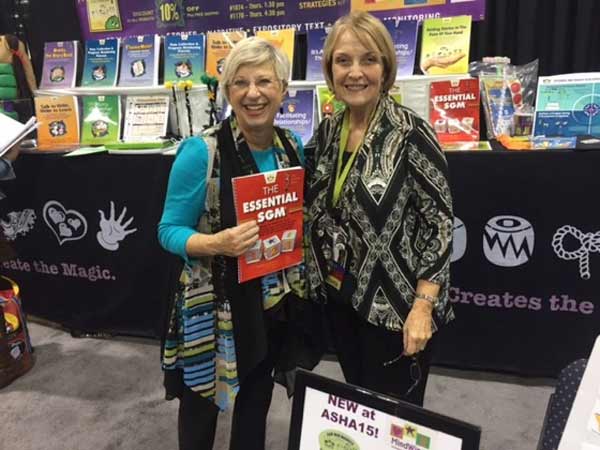 I was delighted to receive this picture from friend and colleague Dr. Judy Montgomery at the
  Kick-Off of “SGM® Week” at Chapman University in Orange, California. This picture was taken at the 2015 ASHA Convention in Denver and showcases our newest publication (at the time) The Essential SGM®. Judy has been interested in the SGM® and narrative development for many years and approached Maryellen three years ago about the need for a manual written especially for college professors of Communication Disorders and Special Education Programs. She volunteered to write the Foreword...


3 Ways SGM® Bolsters the Role of Narrative Development in Collaboration

Orange County Public Schools
Orlando, Florida 2007
As a speech language pathologist, I am a member of two of American Speech, Language and Hearing Association’s (ASHA) Special Interest Groups: Divisions 1 & 16. Both relate to schools and to students who are having problems with language and literacy. It has long been my thought, as many of you know, that discourse level language skills, those that extend beyond the sentence as students strive to express personal stories, story retells and expression of content area knowledge, are oral language skills that are vital and foundational to academic learning and social success...
The Importance of Narrative Development in School and in Life
Having worked within the dual fields of speech/language pathology and reading/writing disabilities for the past 35 years, I see the ability to comprehend and/or express a story as vital to both academic and social success. Our conversations with family and friends are made up of stories, about ourselves, and others. We take perspectives of others through stories, we are asked to analyze the actions of characters and even notice their facial expressions and feelings in stories (books and TV) and in life as we strive to understand human nature: why people do what they do...


SGM® Summer Study Series
When asking a child how he or she feels or asking how they think a character feels, the answer is often happy, sad or mad. Occasionally you could get an answer like "scared." MindWing Concepts' manuals for Braidy the StoryBraid® as well as It's All About the Story portray the 6 universal feelings (right). We encourage children to use synonyms for these "feelings" words that also indicate the degrees and nuances of happiness, sadness or anger that they themselves or a character might be feeling. Below are lists of synonyms for the six universal feelings.
MindWing also created an 18"x24" Feelings poster and a Feelings mini poster to help to inspire the use of different emotion words for when children are telling or writing a story, to make the "feelings" more explicit. But, not all "feelings" are the same.
In an article called "Picturebooks and Emotional Literacy" in The Reading Teacher, the author explains that "although there are emotions for all shades and degrees of joys, sadness and anger, it is problematic to create a universal facial expression for envy or pride" (Nikolajeva, p.253). These emotions can be called social emotions. "Unlike basic [universal] emotions, social or higher cognitive emotions such as love, guilt, shame, pride, envy and jealousy are not innate, or least considerably less innate than basic emotions and may be culturally dependent" (Nilolajeva, p.252).


April 17, 2020: Casey’s Personal Narrative, FB Live
Today’s mini-lesson contains TWO FREE LESSONS. It contains a personal narrative interaction between Maryellen and Casey using the SGM® manipulative and mini-magnets (one lesson). Since it is Patriot’s Day, celebrated as a holiday in Massachusetts and Maine on Monday, we have provided a handout regarding the content of “Paul Revere’s Ride” by Henry Wadsworth Longfellow (a second lesson). Patriot’s Day is usually the run of the Boston Marathon. The Marathon will be held this year in September, 2020 due to the effects of the COVID10 pandemic on gatherings and functions. Also the Boston Red Sox usually have a home game on that day as well at Fenway Park. It will not be played...
Oral Language and Trauma: “Nobody Made the Connection”
 All of the upcoming MindWing workshops have a social communication component in addition to the need for oral language narratives as a base for literacy. The title above is exactly what we are attempting and intending to do! Make the oral language, particularly the narrative language connection, to vulnerable children in our care. The ability to tell one’s own personal story, independent of prompting by others is of vital importance to children (and adults, for that matter!) throughout the world. The Story Grammar Marker® tools and approach serve this purpose: hands-on, self-cueing, icon-based system, multisensory in construct, following evidence-based social communication focus as well as application to academics in the areas of oral language, retelling, and writing!...
Why MindWing’s Materials and Methodology Are Truly CCSS-Aligned
In light of our upcoming July 17th workshop in Natick, MA called The “Core” of the Core: Using Story Grammar Marker® to Support Learning Challenged & “At Risk” Students in Meeting Grade-Level Common Core State Standards, we wanted to share with you a response sent to Maryellen by a colleague who is a Reading/Language Arts Specialist K-8 in a school district in Connecticut. She explains why she thinks that MindWing’s materials and methodology are the only ones that are truly “CCSS-aligned!” This message shows the concrete and practical way that our methodology supports the CCSS, which is actually the basis for the workshop on July 17th in Natick...
Inference: Students Don’t Know What They Don’t Know!
Help them ask Who, What, When, Where & Why Using the Story Grammar Marker®
Children often “don’t know” what they “don’t know!” Using the Story Grammar Marker® manipulative, parents, teachers and specialists can give children the ability to ASK AND ANSWER “Wh” questions such as: Who, What, When, Where and Why. Development of these abilities improves children’s oral language, writing, critical thinking and comprehension. It also especially can help children in social situations and conversations.


Informational Text Focus for Middle Age Students
 A recent question from a colleague on our Official Story Grammar Marker® Facebook Professional Learning Community:
What are your recommendations for working on listening comprehension and written language for middle age students? Thanks for your question, Sarah. In the twenty five years since the first Story Grammar Marker® was used in a classroom, we, at MindWing Concepts, Inc. have created multiple manuals and materials for tweens, and teens as they struggle with the text and how to communicate their responses to it. The academic focus gradually becomes the text of information, also called “expository text.” It is the text of science and social studies and the like...
Letter from a Parent of A Child with Autism
I have a 6.5 year old son who has high functioning Autism. His Test of Narrative Language is at 3% for both receptive and expressive components. I introduced the Story Grammar Marker® to him this week and we went over the book “Big Al” by Andrew Clements together a couple of times, as described in your new book “It’s All About the Story.” I am thrilled to tell you that at dinner time a couple of days later, we were talking about our “ho-hum” day, and I mentioned to my husband that I got a headache in the morning. My son took over and said: “That was a kick-off!” I was shocked to see how quickly he grasped the tool that he calls “Grandma's Story Marker” :-)...


SGM® a Powerful Force in Time of Crisis
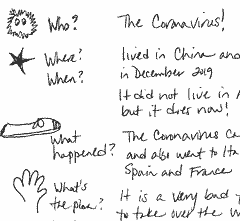 Hello Maryellen, My 4th grade client just completed this during his session—thought you would like to see! I’m not the best at all the ins and outs of Story Grammar Marker® but I wanted you to know how powerful it is for children in this time of unexpected crisis! This client is 10 years old, and diagnosed high-functioning autism spectrum disorder and anxiety disorder. He’s so upset about having to homeschool, in tears at the beginning of the session. Sorry my handwriting isn’t a little more legible, but I was writing in a hurry as he was creating his narrative while holding the student SGM® tool in his hands! By the end of our session, after working things out with SGM®, he generated the three things that are nice about homeschooling—all by himself! I love your work and have happily used SGM® with this client for about a year now, once a week in private speech. Thank you so much for all you do!...


SGM is 25 Years Old & SGM New Year’s Resolution Worksheet
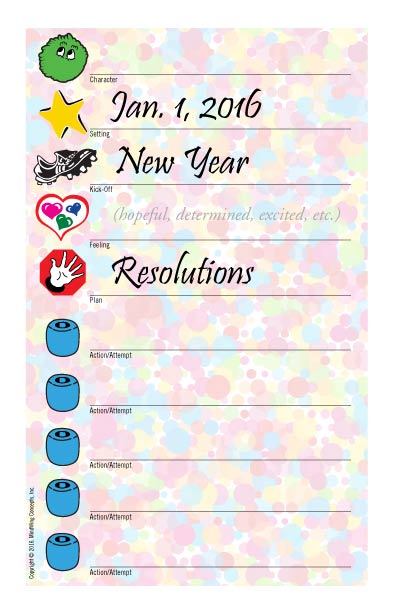
Happy New Year!
The Story Grammar Marker® is twenty-five years old this year, created in 1991. 2016 will be a year of celebrations that highlight our methodology as well as tools for instruction and intervention. To kick off the year, please use this new “SGM® New Year’s Resolution Worksheet” (click here to download and print) with your students...


Understanding Novels / Chapter Books with SGM

This year, one of our website goals is to provide lessons using novels, chapters from chapter books, short stories and, yes, picture books for clinicians and teachers who work with middle and high school students who are in need of discourse level language development services. On our yearly visit to each of the boroughs of New York City in December, 2015, many participants asked for such “higher level” examples.
It is important to note that picture books are key to development of narrative thought, social communication and inference building through the recognition of literary elements such as feelings, plans, mental states of characters through the coupling of illustrations and text. Often the clues to these vital elements are not visible when illustrations are not available...


More Connections of the SGM® to the DRA (Developmental Reading Assessment)

“As noted in the previous blog about the DRA, there are many ways to assess the ability to retell a story. A rubric, such as that used on the DRA, is one of them. Other comprehension assessments tap the Wh Questions or general story rubrics to guide assessment. In my experience, there are students who can answer these questions but are not able to retell what they read. Although the causes may be different, the problem is similar, they are unable to express what was comprehended. There are others who are unable to answer questions unless there is focused scaffolding and then only minimal responses are noted. Still, there are others who are “word callers” and have mastered the decoding process but do not comprehend what they are reading. Finally, there are students with language problems who have working memory or word retrieval problems and have difficulty expressing what they comprehend...”


Lesson Idea From A Virtual Meet & Greet with a 3rd Grade PLC
 Yesterday, we did a “Virtual Meet and Greet” with a 3rd Grade PLC in a school district in Connecticut. The 3rd grade teachers, special educators and specialists were all on Google Meets, and then Sheila and I joined for 30 minutes as guests. One of the questions that came about was in regard to the book “Officer Buckle and Gloria” by Peggy Rathmann. I love when I get asked about books that I have not previously analyzed, as it gives me the opportunity to showcase the flexibility of SGM®! Here is my analysis below. I love to use these “seemingly simple” books with older students to have them investigate and talk about complexities within episodic organization and the use of vocabulary words (feelings/thoughts) and also cohesion within sentences as the students strive to discuss the book...
Another Successful ASHA Convention in Atlanta!
Well, another ASHA Convention has come and gone and we are on our way into the holiday season! We enjoyed ASHA ATLANTA!
We enjoyed seeing so many friends and colleagues and met so many new SLPs! We want to thank our team at the booth for all of their help in answering questions and explaining Story Grammar Marker® to SLPs visiting the booth.
Judy K. Montgomery visited the booth and met with Maryellen Rooney Moreau about their NEW BOOK coming in 2013 that is for University and College professors and their graduate students. More information about this new book is coming soon!...


A Hopeful Message for the New Year: “The Rabbit Listened” by Cori Doerrfeld
 In celebration of the New Year, we want to focus on a message of “hope,” so we have chosen a selection of children's literature called The Rabbit Listened, by Cori Doerrfeld, for use with the Story Grammar Marker® or Braidy the StoryBraid® in school, for remote learning, or at home! In this Blog post, we will share an analysis of story elements and narrative structure using Story Grammar Marker® icons, a discussion of the message and metaphoric meaning, as well as activities with FREE downloads (found toward end of post)...


ASHA ATLANTA 2012

We are looking forward to seeing you at ASHA this week!
Please visit us at Booth #1220 for raffles, special offers and to say hello! Also, you can get our new Character Mini-Magnets (below) FREE with the purchase of our new book: The “Core” of the Core.
We would love to see you at our session #1441: “The SLP & Literacy Night: Supporting Common Core State Standards” by Maryellen Rooney Moreau, M.Ed., CCC-SLP and Linda Lafontaine, M.A., CCC-SLP, Saturday, November 17, 9:30am-10:30am...
Three Ways to Visit and Reconnect at the ASHA Convention 2010 Next Week in Philly!
It’s that time of year, again – time to reconnect with our friends and colleagues at the American Speech and Hearing Association Conference, this year in Philadelphia.
- We will be at Booth #215 with product demos, videos, special give-aways and prizes! If you mention reading this BLOG or getting our E-Newsletter, you will be entered in a special drawing with a chance to win The Autism Collection Kit!
- In addition to our Booth #215, Maryellen Rooney Moreau will be presenting on the topic of Autism Spectrum Disorders in session #0303, Thursday, November 18, 9:30AM-10:30AM in Room CC/106B. This session is entitled: “It’s All About the Story: The Language-Thinking-Social Connection” and will highlight our new Autism Collection: It’s All About the Story and Making Connections...


25 Years of SGM / Special Anniversary Offer
Happy 25th Anniversary to Story Grammar Marker®!
In honor of this milestone, we are offering a SPECIAL back-to-school 25% Discount for all online orders through September 9, 2016. SEE BLOG FOR DETAILS.
It has been 25 years since Maryellen Rooney Moreau, M.Ed. CCC-SLP created the Story Grammar Marker® at her kitchen table and piloted it at the Curtis Blake Day School in Springfield, Massachusetts. In the 1980s and early 1990s, Maryellen was Curriculum Director and co-taught at the Curtis Blake Day School...


Teaching “Kindness” and Other “Feelings”
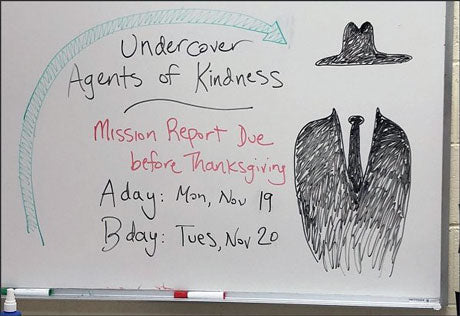 When viewing the emails on my computer today, I came across an article from Education Week Teacher entitled “Want Your Children to be Kinder? Try This Assignment” by Justin Parmenter. The author encouraged his students to be “Undercover Agents of Kindness” as they each drew the name of a classmate and planned to perform a mission of kindness: “an unexpected act of kindness for the classmate.” After doing the unexpected act of kindness, the students were asked to write a “mission report,” “detailing what they did and how it went.”...
Fall Travels and Topics

This week I want to mention our upcoming professional development trips to San Antonio to Billings to New York City to Denver! The stops on our itinerary show the varied text structures, academic language and social communication applications of our language learning tools.
I am speaking at the Dr. Elizabeth Carrow-Woolfolk Lecture Series on Saturday, October 10, at Our Lady of the Lake University in San Antonio, Texas. It is an honor to be invited to speak at this event since I have long admired Dr. Carrow-Woolfolk’s contributions as a pioneer in the study of language and reading disabilities. My presentation will center on narrative and expository discourse language development using Story Grammar Marker® and ThemeMaker® ...


May 6, 2020: Thoughtful poetry for all times…
 Woodson, J. (2014). Brown Girl Dreaming. NY: Putnam. This is a book of poetry centering on the author’s life experiences growing up in Ohio. She remembers life as a child and applies these memories to her future. There are two poems that I would like to cite: “every wish, one dream,” (pages 313–314) and “it’ll be scary sometimes,” (pages 13–14). The first selection is about Woodson’s dream of becoming a writer. As many writers have, she has read much and remembered the themes, lines of stories and poems, and their life lessons. As I read the passage to you, think about her expression of her life’s goal. The second poem is about a memory from early life stories about family experiences from past generations. Handout Available...


May 5, 2020: A book of short stories with serious messages through many voices
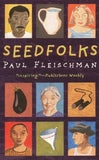
Fleischman, R. (2004). Seedfolks. NY: Harper Trophy. This is a collection of voices of people who, in one way or another, relate to a vacant lot in Cleveland, Ohio, during the 1930s. The vacant lot is full of smelly trash dumped there over a period of years. Gradually, people are drawn to the site to plant, see things grow and to socialize. All are people who have sustained great hardships in life. Each short chapter is a snippet of their experience, mostly as immigrants to our country. I’ve selected the character Leona as a focus for this lesson. Leona’s chapter begins with a memory of her grandmother. The memory centered on goldenrod tea with a nutmeg floating in it. Her grandmother drank it every day to ward off illness…and any doctor! There are several kick-offs that signal mini-episodes within this short story. Handout Available...


May 1, 2020: “And Then It Happened”—Books for Older Students
 Wade, M & L. (2006). And Then It Happened. Ontario, Canada: Books for Boys. This series of books was given to me when I was in Ontario, Canada, presenting about narrative development. I thought I would present one of these stories today since there is an opportunity to have a little fun with the content of these volumes. The short stories are written for boys (and girls) between grades 3 & 6. The website www.boysbookshelf.com provides a sample short story from each of the volumes as well as listings of all the Canadian school systems visited by Michael Wade, one of the authors. My favorite story is “The Giant Cupcakes.” I have used it as reader’s theater with props. It is lots of fun. There are several Kick-Offs throughout this short story. Handout Available...


April 29, 2020: Esperanza Rising’s Theme of Hope: A Book for Use with Older Students

Today, I am continuing discussing the books that I recommended yesterday for students who are older and would like to read short stories, verse and novels. I cited eight titles and provided annotations for each. Each of the books focuses on the theme of resilience and with the ability to take perspective of self and others, students will be able to “see themselves through others’ experiences” and reflect on their lives in general. During the next several days, I will provide a glimpse into each book and refer to the Story Grammar Marker®. Today we will apply the Story Grammar Marker® to Esperanza Rising, chapter 1. I chose Esperanza Rising as the first in this series since Esperanza means “HOPE.” Hope is a vital character trait for us to focus on during these times. Through literature, students learn about themselves, through others’ experiences. They see resilience in action!


April 28, 2020: Book List for Older Students During COVID19, FB Live

Today, we talk about a list of books for older children. These books are great for teaching components of narrative development using our Story Grammar Marker® icons. If you and your students understand these components and can use them to focus the discussion of the story itself, they will be better at listening and reading comprehension. Each of the following lend themselves to a read-aloud, although each may be read traditionally. Also, each of the stories have some form of information, knowledge, used by the various authors. For instance, dePaola’s book begins with a hurricane; Fleischman’s concerns a garden: planting, sunlight, vegetables, etc...


April 24, 2020: Final Lesson Ideas for Settings, FB Live

Last of 3-Day Lesson Ideas for Settings: When choosing Big Red Barn as a follow-up to the “At the Farm” assigned passage, my purpose–as a parent at home–was to use the book to elaborate on the topic that was presented in the assigned passage, as a teacher may do in school. I wasn’t worried about lexiles. I wanted a book that would appeal to a child in kindergarten to read for fun and maybe to teach a few things. When looking through Big Red Barn I found many elaborations!


April 23, 2020: More On Settings, FB Live

Lesson Outcome: After completing this sequence, you will have expanded the initial lesson “At the Farm” provided for the student. Furthermore, you will have learned how to differentiate a lesson for children of different abilities. Also, you will have noticed that there are many levels within the activity: there will be some students who are able to tell a personal narrative readily. At the same time, there will be students who are at the stage of assembling the animals in order and putting them into the “barn.” Both children are learning the “personal narrative sequence” and will progress at their own pace...


April 22, 2020: More About Settings, FB Live
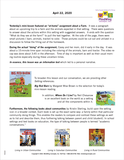
To broaden this lesson about settings and our conversation about a farm, we are providing other setting references: Big Red Barn by Margaret Wise Brown is the selection for today’s mini-lesson reading. Other suggestions are provided in the handout...


April 20, 2020: COVID19 Uncertain Times, FB Live
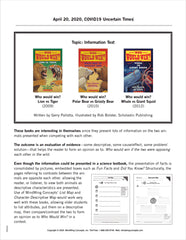
The “Who Would Win…” books are interesting in themselves since they present lots of information on the two animals presented when competing with each other. The outcome is an evaluation of evidence—some descriptive, some cause/effect, some problem/solution—that helps the reader to form an opinion as to: Who would win, it the two were opposing each other in the wild. Even though the information could be presented in a science text book, the presentation of facts is consolidated by pictures, embedded boxes such as Fun Facts and Did You Know? Structurally, the pages referring to contrasts between the animals are opposite each other, allowing the reader, or listener, to view both animals as descriptive...