

Search
59 results found for "Sheila Moreau"
Perspective Taking in Literature
Maryellen Rooney Moreau presented last weekend at Michelle Garcia Winner’s Social Thinking Providers’ Conference in San Francisco. In 2003, Winner stated: “Perspective taking is needed for social interaction, academic success and personal problem-solving as an adult.” Social Thinking, the work of Winner, heavily focuses on perspective-taking. Maryellen’s presentation, meant to exemplify this statement, was called Let’s Think About It! Perspective-taking And The Thought Process Of Opinion/Argument Using The Story Grammar Marker®. In her presentation she covered the following topics:
- Narrative development in relation to perspective taking
- Speaking and listening Common Core State Standards and narrative development
- The role of mental models and social emotions in perspective taking
- The Situation Model and the Story Grammar Marker®
- Critical thinking and its relation to perspective-taking and argument
- The shift to Expository text structures in ELA due to the Common Core State Standards
- Thinking about, planning and writing opinion & argument


SGM® Summer Study Series
When asking a child how he or she feels or asking how they think a character feels, the answer is often happy, sad or mad. Occasionally you could get an answer like "scared." MindWing Concepts' manuals for Braidy the StoryBraid® as well as It's All About the Story portray the 6 universal feelings (right). We encourage children to use synonyms for these "feelings" words that also indicate the degrees and nuances of happiness, sadness or anger that they themselves or a character might be feeling. Below are lists of synonyms for the six universal feelings.
MindWing also created an 18"x24" Feelings poster and a Feelings mini poster to help to inspire the use of different emotion words for when children are telling or writing a story, to make the "feelings" more explicit. But, not all "feelings" are the same.
In an article called "Picturebooks and Emotional Literacy" in The Reading Teacher, the author explains that "although there are emotions for all shades and degrees of joys, sadness and anger, it is problematic to create a universal facial expression for envy or pride" (Nikolajeva, p.253). These emotions can be called social emotions. "Unlike basic [universal] emotions, social or higher cognitive emotions such as love, guilt, shame, pride, envy and jealousy are not innate, or least considerably less innate than basic emotions and may be culturally dependent" (Nilolajeva, p.252).


Mondays with Maryellen
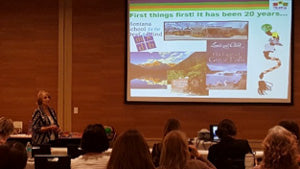 Hi Everyone! I’m sorry this post is a couple of days late – “Mondays with Maryellen” is on Wednesday this week ☺. We just returned from a whirlwind series of workshops in both San Antonio, Texas and Billings, Montana. We had great audiences, fabulous times with colleagues, and of course the San Antonio RiverWalk, the Alamo and the Big Sky Sunsets were marvelous to visit. Sheila’s 20-month-old daughter Casey and our friend Mary accompanied us on this trip — we’ve included some photos!
San Antonio was 95 degrees – wow! Billings was comfortable in the 70s. However, when we returned to Massachusetts, it was to a 19-degree morning! Alas, Fall, the prelude to snow in New England!
The trip to Billings and the return to the 19-degree morning prompt me to relate a new invitation we’ve received: A visit to Alaska upon the invitation of AKSHA—Alaska Speech Language and Hearing Association 2016 Convention next October...


Feelings, Perspective Taking, Theory of Mind, Empathy
 Our recent blog, The Snow Walker, concluded our three-part winter-themed blogs (for this year!). We are hopefully moving towards warmer temperatures, as we begin April. April also begins National Autism Awareness Month. In light of that, throughout the month, our blogs will focus on the development of feelings, perspective taking, theory of mind, and empathy. The Story Grammar Marker® provides a visual, explicit way of analyzing the motivations, feelings, thoughts/mental states and plans of characters (and of people in real life situations).
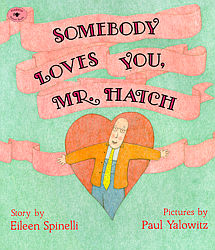
Picture books are excellent resources for helping to develop children’s emotional literacy. As educators, we know that combining visual images and text plays a significant role in working with our students. In an article in The Reading Teacher (Vol. 67, Issue 4, December 2013/2014), Maria Nikolajeva writes that “picturebooks are perfect training fields for young people’s theory of mind and empathy.” In this blog, we are going to use the book Somebody Loves You, Mr. Hatch written by Eileen Spinelli and illustrated by Paul Yalowitz to begin to demonstrate feelings, theory of mind, perspective taking and empathy.


Lesson Idea From A Virtual Meet & Greet with a 3rd Grade PLC
 Yesterday, we did a “Virtual Meet and Greet” with a 3rd Grade PLC in a school district in Connecticut. The 3rd grade teachers, special educators and specialists were all on Google Meets, and then Sheila and I joined for 30 minutes as guests. One of the questions that came about was in regard to the book “Officer Buckle and Gloria” by Peggy Rathmann. I love when I get asked about books that I have not previously analyzed, as it gives me the opportunity to showcase the flexibility of SGM®! Here is my analysis below. I love to use these “seemingly simple” books with older students to have them investigate and talk about complexities within episodic organization and the use of vocabulary words (feelings/thoughts) and also cohesion within sentences as the students strive to discuss the book...


SLPs: Be Empowered to Collaborate!
 In the early 1970s, I began my work as a Speech/Language Pathologist in the Hartford, Connecticut Public Schools. The department head, Margaret Kennedy, an Iowa native, was trying to entice someone to teach a “Language Disabilities Class” at Dwight School in the South End. Language Disability was the new term in our field at that time. I had just gotten my Master’s Degree at Penn State and had an enlightening summer course in “language disabilities” under my belt. We used Helmer Myklebust’s text entitled Differential Diagnosis of Language Impairments, as our basic text and studied intervention methodologies such as the Association Method, developed at Central Institute for the Deaf in St. Louis, the ITPA, Auditory Discrimination in Depth (now known as Lindamood/Lindamood)...


A Hopeful Message for the New Year: “The Rabbit Listened” by Cori Doerrfeld
 In celebration of the New Year, we want to focus on a message of “hope,” so we have chosen a selection of children's literature called The Rabbit Listened, by Cori Doerrfeld, for use with the Story Grammar Marker® or Braidy the StoryBraid® in school, for remote learning, or at home! In this Blog post, we will share an analysis of story elements and narrative structure using Story Grammar Marker® icons, a discussion of the message and metaphoric meaning, as well as activities with FREE downloads (found toward end of post)...


Elephants Get the Hiccups?! Fun Lesson Teaching Kick-Offs and Compare/Contrast

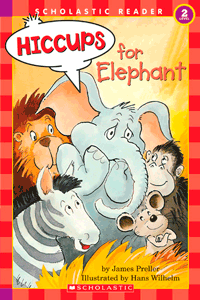
Recently, I came across two books at my local library that both had the same Kick-Off: Hiccups for Elephant by James Preller and Clifford’s Hiccups adapted by Suzanne Weyn. In each, the main Character in the story has the hiccups. Maryellen Moreau has completed a workshop activity using the Preller book shown below. In the Hiccups for Elephant book, the hiccups that the elephant has is an Initiating Event (Kick-Off) for the animals in the forest who do not like being awakened by the hiccups, and each have a remedy to offer. The elephant, himself, is not seeking a remedy...


St. Patrick’s Day Lesson on Settings: “The Leprechaun’s Gold”
 On a recent visit to Springfield’s Sixteen Acres Library, I was pleased to see a large display of books related to St. Patrick’s Day. One that caught my eye is The Leprechaun’s Gold written by Pamela Duncan Edwards and illustrated by Henry Cole. After reading The Leprechaun’s Gold, I immediately thought that this would make a great lesson to focus on how a change in the Setting signified a new episode, and how all three of the settings and episodes in this picture book overlap, as so often happens in chapter books. There are so many other aspects to this book also, such as character interactions and comparisons, and developing skills in identifying character traits. The book also lends itself to a quick project using a shamrock cut-out...


Spiders! 5 Books, Resources and Activities
 As so often happens when I see a certain book or project, it reminds me of particular lessons that I taught while teaching at the former Juniper Park School in Westfield, MA. A recent display of books on spiders at our local library did just that. Below are some ideas on spider-related books that you may want to try this summer or tuck them away in your files for future use. In addition to other resources, several of the selections below are Anansi trickster tales which were first told by the Ashanti people in Ghana. We begin our lesson suggestions with one of the Anansi stories adapted and retold by Eric A. Kimmel and illustrated by Janet Stevens. These were always popular with second and third graders. I liked to use them to reinforce the SGM® complete and interactive episodes and character traits...


Tech Tuesday: Using Emoji in Narrative Analysis

A friend’s Emoji creation in the SnapChat app.
In selecting topics for Technology Tuesday, I find it helpful to “piggy back” on my own clinical work, of course, but also on topics that have recently appeared on this blog. Recently, Sheila Moreau wrote in a MindWing blog about the power of emoji for understanding narrative events, identifying emotions, and expressing empathy, particularly in relation to Facebook’s recent incorporation of a range of reactions available to use in response to others’ posts. While emoji are a narrative phenomenon changing our (and teens’) reaction to social media (note that they have always been present in the “much-cooler” Snapchat), there are also ways to use them as visual tools out of the context of social media, a place where clinicians may not “want to go” with students...